
FBA vs FBM vs Hybrid: The Fulfillment – Ranking Connection
Amazon pulled in $716.9 billion in net sales in 2025, and if you’re selling on the platform, you already know how crowded it is. What a lot of sellers don’t think hard enough about is how their fulfillment setup (FBA, FBM, or some mix of both) actually affects their search rankings, not just their logistics.
The way you fulfill orders ties directly into how Amazon decides to show your listings, which customers find you, and how much money you keep at the end of the day. We’re going to break down each fulfillment method and look at how it connects to your SEO performance so you can make smarter calls about what actually works for your business.
The Critical Choice: Why Fulfillment Strategy is Your Secret Weapon for Amazon Success
Your fulfillment strategy dictates how products reach the customer. This impacts everything from delivery speed and customer service to your cost structure and eligibility for key Amazon programs like Prime. In an environment where conversion rates are king, and customer expectations for fast, reliable shipping are sky-high, your fulfillment choice is not just about logistics; it’s about leveraging the Amazon marketplace to your advantage. Approximately 82% of active Amazon marketplace sellers utilized Fulfillment by Amazon (FBA) in 2025, underscoring its popularity and perceived benefits for reaching a vast customer base FBA Adoption Rate. However, popularity doesn’t always equate to optimal strategy for every seller.
What You’ll Master: Aligning Fulfillment with Amazon SEO for Maximum Sales & Profit
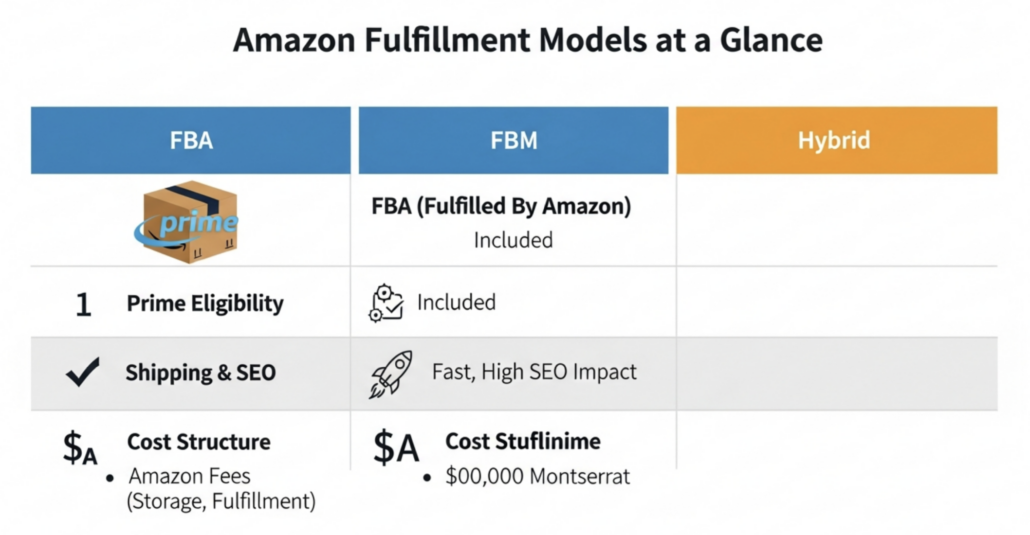
A side-by-side comparison of the key trade-offs between FBA, FBM, and Hybrid fulfillment strategies.
This guide will demystify the FBA vs. FBM vs. Hybrid debate. You’ll learn how each method uniquely influences your Amazon SEO ranking factors, understand the direct impact on your profit margins, and discover how to leverage data for informed decision-making. We will provide a strategic playbook to help you implement the right fulfillment approach for each of your products, ensuring your content, advertising, and inventory management work in concert with your chosen fulfillment to drive unprecedented sales and profitability.
FBA: Leveraging Amazon’s Fulfillment Network for SEO Dominance
Fulfillment by Amazon (FBA) remains the most popular fulfillment method for a reason, offering sellers access to Amazon’s vast logistics infrastructure.
What is FBA? (Fulfillment by Amazon)
With FBA, sellers ship their products in bulk to Amazon’s fulfillment centers. Amazon then handles storage, inventory management, pick-and-pack processes, shipping to the customer, and customer service for those orders. This service allows sellers to tap into Amazon’s extensive Fulfillment Network, ensuring products are readily available and efficiently delivered.
FBA’s Direct Impact on Amazon SEO & Conversion
The most significant SEO benefit of FBA is eligibility for the Prime badge. Listings with the Prime badge are prioritized in search results and benefit from significantly higher conversion rates, as customers increasingly expect fast, free shipping. Beyond Prime, FBA often leads to faster shipping times, which Amazon’s algorithm favors, improving search ranking. Furthermore, Amazon’s efficient handling of fulfillment and customer service can positively impact your seller metrics, such as Order Defect Rate (ODR) and response times, which are crucial for maintaining and improving your SEO standing.
FBA’s Profit Implications: Balancing Costs with Sales Potential
While FBA offers convenience and SEO advantages, it comes with associated costs. Sellers incur FBA fees for each unit sold, covering fulfillment, shipping, and customer service. Additionally, Storage Fees apply to inventory held in Amazon’s fulfillment centers, with higher rates for slow-moving items. These costs must be carefully weighed against the potential increase in sales volume and conversion rates driven by Prime eligibility. Analyzing these FBA fees is essential for maintaining healthy profit margins.
FBM: Strategic Control for Targeted SEO & Optimized Profitability
Fulfillment by Merchant (FBM) puts the seller in complete control of the entire fulfillment process.
What is FBM? (Fulfillment by Merchant)
Under FBM, sellers are responsible for storing their own inventory, typically in their own warehouse or a third-party logistics (3PL) provider. They manage packaging, shipping directly to the customer, and all customer service inquiries. This method offers greater autonomy over product presentation and the shipping experience.
FBM’s Unique SEO & Profit Levers
FBM allows for greater control over shipping costs and times, which can be advantageous for certain product types or when targeting specific profit margins. While FBM listings typically don’t qualify for the Prime badge by default, sellers can achieve this status through the Seller Fulfilled Prime (SFP) program, which has strict performance requirements. Successfully meeting SFP criteria can unlock significant SEO benefits and conversion rate improvements similar to FBA, but with greater control over the supply chain. Furthermore, FBM can lead to higher profit margins by avoiding FBA fees, especially for low-cost, high-volume items or oversized products where FBA fees can become prohibitive.
Seller Fulfilled Prime (SFP): The FBM SEO Accelerator
The SFP program is a game-changer for FBM sellers. By meeting stringent performance standards for shipping speed, delivery rates, and cancellation rates, sellers can earn the coveted Prime badge for their FBM items. This offers the best of both worlds: the SEO and conversion benefits of Prime with the operational control of FBM. However, maintaining SFP status requires meticulous inventory management and reliable shipping operations.
FBM Challenges & Potential SEO Risks
The primary challenge with FBM is meeting Amazon’s demanding shipping standards consistently. Failure to do so can result in a loss of the Prime badge (if applicable) and negatively impact seller performance metrics, which can harm SEO. The increased workload associated with managing inventory, packaging, and shipping can also be a significant burden. Without the Prime badge, FBM listings may experience lower conversion rates compared to FBA or SFP listings due to customer preference for expedited, predictable shipping.
Data-Driven Decisions: Analyzing & Optimizing for SEO, Sales & Profit
To master your fulfillment strategy and its impact on SEO and profit, data analysis is indispensable.
Key Performance Indicators (KPIs) for Holistic Fulfillment & SEO Health
Essential KPIs include conversion rates, sales velocity, seller feedback scores, Order Defect Rate (ODR), shipping performance metrics, and profit margins per ASIN. Analyzing these metrics allows you to gauge the effectiveness of your chosen fulfillment method on both customer acquisition (SEO) and financial performance (profit).
Leveraging Amazon Seller Central & External Analytics Tools
Amazon Seller Central provides robust reports on sales, inventory, and performance. Dive into your sales dashboard, inventory reports, and customer feedback to understand product movement and customer satisfaction. External analytics tools can offer deeper insights into keyword ranking, competitor analysis, and advertising performance, helping you correlate fulfillment strategies with SEO outcomes and advertising ROI. The global e-commerce logistics market’s projected growth to $2498.8 billion by 2034 underscores the increasing significance of efficient data analysis in this sector E-Commerce Logistics Growth.
Performing a Comprehensive Fulfillment & SEO Cost Comparison
Conduct a thorough cost comparison of FBA, FBM, and potential hybrid models for each of your products. Factor in FBA fees, storage fees, shipping costs, packaging materials, labor, advertising spend, and potential return rates. This granular analysis will reveal which fulfillment method offers the best profit margins for each ASIN while simultaneously supporting your SEO objectives. Consider how fulfillment speed impacts your advertising effectiveness, especially as Amazon’s advertising revenue reached $56.2 billion in 2024 Amazon Advertising Revenue.
Implementing Your Master Fulfillment & SEO Strategy: A Playbook for Growth
A strategic approach to fulfillment and SEO requires careful planning and execution.
Step 1: Audit Your Current Product Portfolio & Performance
Analyze your existing product catalog. Identify best-sellers, slow-moving items, high-margin products, and those with unique shipping requirements. Understand current sales data, customer reviews, and competitor strategies for each.
Step 2: Define Your Fulfillment Strategy Per ASIN
Based on your audit and cost analysis, assign the optimal fulfillment strategy (FBA, FBM, or Hybrid) to each ASIN. For example, fast-moving, low-cost items might thrive with FBA, while large, heavy, or niche items might be better suited for FBM. A hybrid model can optimize inventory management by utilizing FBA for popular SKUs and FBM for others.
Step 3: Optimize Your Listing Content for the Chosen Fulfillment Method
Tailor your listing content to highlight the benefits of your chosen fulfillment. For FBA, emphasize “Prime eligible” and fast delivery. For FBM, focus on the quality of your shipping and direct customer service. Ensure your content is optimized for Amazon’s search algorithm, including relevant keywords and compelling product descriptions. Remember that with search tools like Rufus gaining traction, with 250 million users in 2025, optimizing for AI is key Rufus Usage Statistics.
Step 4: Continuous Monitoring and Adaptation
The Amazon marketplace is constantly evolving. Regularly monitor your KPIs, track changes in Amazon’s policies and fees, and stay abreast of competitor strategies. Be prepared to adapt your fulfillment and SEO strategies as needed to maintain optimal performance and profitability.
Future-Proofing Your Amazon Business
Long-term success on Amazon requires foresight and adaptability in both fulfillment and SEO.
Navigating Amazon’s Evolving Landscape: Adapting to Fee Increases and Policy Shifts
Amazon frequently adjusts its fee structure and policies. A flexible fulfillment strategy, potentially incorporating hybrid models or leveraging FBM for certain products, can help mitigate the impact of rising FBA fees or new storage regulations. Staying informed and agile is crucial.
Scaling Your Operations: Considerations for International Warehouses and Global Expansion
As your business grows, consider how your fulfillment strategy supports international expansion. FBA offers global reach, but FBM can provide cost-effective solutions for specific international markets if managed efficiently. Analyzing your global inventory management needs will be paramount.
The Enduring Role of Brand Building and Customer Loyalty in Long-Term Success
Regardless of your fulfillment method, building a strong brand and fostering customer loyalty remain cornerstones of sustainable success. Excellent customer service, high-quality products, and a consistent brand experience—supported by your chosen fulfillment—will differentiate you in the crowded Amazon marketplace.
Conclusion: The Strategic Interplay of Fulfillment and SEO for Unrivaled Success
Recap: There’s No One-Size-Fits-All Solution, Only Strategic Alignment
Mastering Amazon SEO for maximum sales and profit is inextricably linked to your fulfillment strategy. FBA offers unparalleled convenience and Prime eligibility, boosting visibility and conversion. FBM provides control, potential cost savings, and the opportunity for optimized profit margins, especially with SFP. A hybrid approach allows for tailored solutions, optimizing for different product types. The key is not to choose one method definitively, but to strategically align FBA, FBM, and hybrid models with your specific product catalog, business goals, and SEO objectives.
Your Path to Maximum Sales & Profit on the Amazon Marketplace
By understanding the unique SEO implications and profit dynamics of each fulfillment method, leveraging data for informed decision-making, and implementing a dynamic, ASIN-specific strategy, you can significantly enhance your visibility and profitability. Continuously audit, optimize, and adapt to navigate the ever-changing Amazon landscape, ensuring your fulfillment strategy acts as a powerful engine for sustained growth and unmatched success on the world’s largest online marketplace.