The Amazon SEO + PPC Flywheel: How Paid Ads Fuel Organic Rank
Amazon is crowded. Not just busy, properly crowded. When you’re up against millions of listings, getting steady visibility and reliable sales isn’t just hard, it can feel like you’re pushing uphill every single day. Yet, within this competitive arena lies a powerful growth mechanism: the symbiotic relationship between Amazon SEO and Amazon PPC.
This article will unveil the secrets of the Amazon SEO + PPC Flywheel, demonstrating how strategic paid advertising doesn’t just drive immediate sales, but actively fuels and accelerates your organic rankings, creating a compounding growth cycle. As Amazon Marketplace is projected to account for 40.4% of US retail e-commerce sales by 2025, understanding this integrated approach is no longer optional; it’s essential for dominance.
We’ll explore how Amazon’s algorithm rewards products that perform, how paid ads provide the initial impetus, and how to optimize your entire presence for maximum impact.
The Challenge of Visibility on Amazon’s Competitive Marketplace
Amazon’s success is built on customer convenience and choice, which translates into an incredibly crowded marketplace. For any given product, numerous competitors are vying for the same customer’s attention. Achieving organic visibility is a significant hurdle, as the top three organic search results on Amazon capture over 60% of clicks, and 70% of Amazon shoppers do not search beyond the first page of results. Without a strategic approach, products can languish in obscurity, regardless of their quality. This intense competition necessitates a proactive strategy that goes beyond simply listing a product and hoping for the best.
Introducing the Amazon SEO + PPC Flywheel: A Symbiotic Growth Strategy
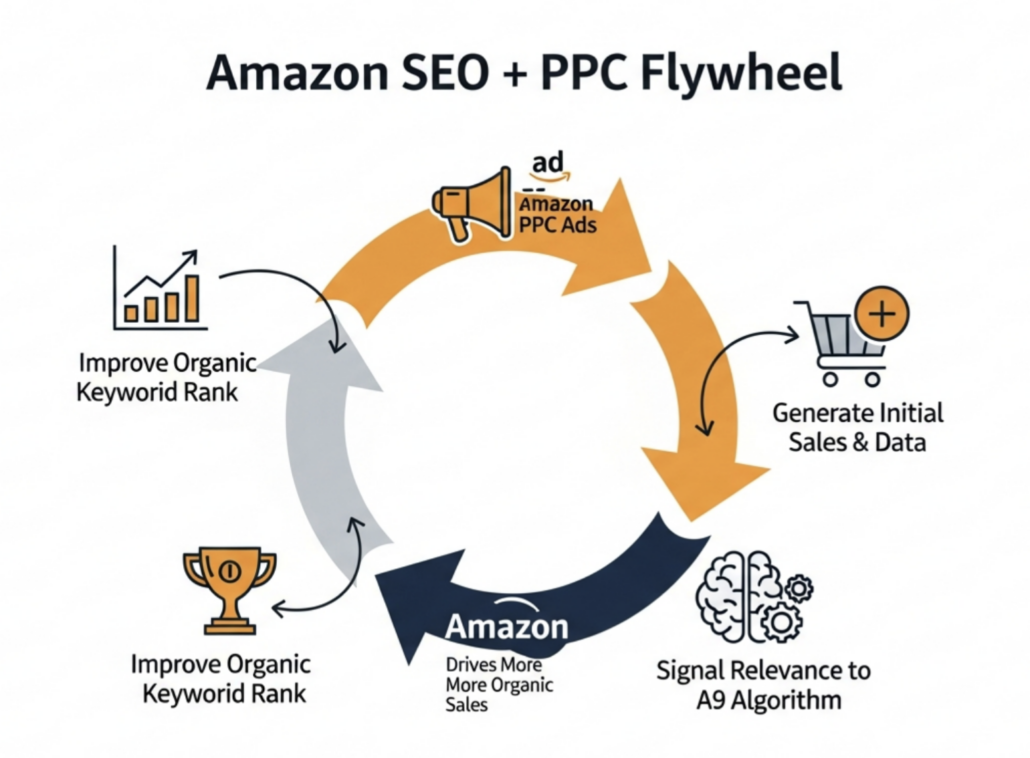
The Amazon SEO + PPC Flywheel: a self-reinforcing cycle where paid ads fuel sales, which improves organic rank, leading to more sustainable growth.
The Amazon SEO + PPC Flywheel is a powerful growth model where Amazon PPC efforts are strategically leveraged to enhance Organic Rankings. This isn’t about choosing between paid and organic; it’s about making them work in concert. Think of it as a snowball effect: initial paid sales create momentum, which signals positive performance to Amazon’s algorithm, leading to improved organic visibility, which then drives more organic sales. This symbiotic growth strategy ensures that every dollar spent on advertising contributes not only to immediate revenue but also to long-term, sustainable organic growth. Understanding this Amazon Flywheel effect is key to unlocking compounding success.
What You’ll Learn: Leveraging Paid Ads for Sustainable Organic Rank
This article will guide you through the intricacies of the Amazon SEO + PPC Flywheel. You’ll learn how Amazon’s algorithm interprets various signals, understand the critical factors that influence organic rankings, and discover precisely how Amazon PPC campaigns can be structured to accelerate this process. We’ll delve into keyword strategies, bidding tactics, and listing optimization, all aimed at creating a powerful engine where paid ads consistently fuel organic performance. By the end, you’ll possess a clear roadmap for leveraging Amazon Advertising to achieve sustained growth.
Understanding the Amazon Flywheel and its Organic Foundation
At its core, Amazon’s business model is designed to benefit the customer, which in turn benefits Amazon. This customer-centric approach is the bedrock of its remarkable growth.
Amazon’s Core Philosophy: The Customer-Centric Flywheel
Amazon’s success is inextricably linked to its obsession with the customer. Every aspect of the platform, from product selection to delivery speed and customer service, is optimized for customer satisfaction. This dedication forms the basis of the Amazon Flywheel: a self-reinforcing cycle of growth driven by customer experience. When customers find what they want, are satisfied with their purchase, and receive it quickly, they return. This repeat business fuels Amazon’s growth, allowing it to offer more selection, better prices, and faster delivery, which further enhances the customer experience, and so on.
The A9/A10 Algorithm: How Amazon Ranks Products
Amazon’s proprietary search algorithm, often referred to as A9 or A10, is the gatekeeper of visibility. Its primary objective is to present the most relevant and highest-converting products to shoppers. It analyzes numerous data points to determine a product’s ranking for a given keyword. Essentially, the algorithm rewards products that customers purchase. This is where the flywheel concept becomes critical; paid advertising can directly influence the signals the algorithm prioritizes.
Key Organic Ranking Factors: What the Algorithm Prioritizes
Several key factors influence a product’s Organic Rankings within Amazon’s search results. These include:
- Sales Velocity: The speed at which a product sells is a paramount signal. High sales velocity indicates popularity and relevance.
- Conversion Rate: The percentage of shoppers who purchase a product after viewing its product page. A high conversion rate tells the algorithm the product meets customer needs.
- Keyword Relevance: Ensuring the product listing is optimized with the keywords customers are actually searching for.
- Customer Reviews and Ratings: Positive feedback and high ratings build trust and influence conversion.
- Product Detail Page Quality: Compelling imagery, persuasive copy, and informative bullet points contribute to a better customer experience and higher conversion.
- Prime Eligibility: Products fulfilled by Amazon (FBA) often receive a ranking boost due to faster shipping and customer trust associated with Prime.
- Click-Through Rate (CTR): The percentage of people who click on your product after seeing it in search results.
The Critical Role of PPC: Igniting the Flywheel
While organic optimization is foundational, Amazon PPC serves as the crucial ignition switch for the Amazon Flywheel, providing the initial momentum needed for sustainable growth.
PPC as the Ignition Switch for Organic Momentum
In a competitive marketplace, it can be difficult for new or even established products to gain initial traction organically. Amazon PPC acts as a powerful catalyst, driving targeted traffic and immediate sales. This influx of activity generates crucial data points and positive signals that the algorithm recognizes. The initial impressions and clicks from paid ads can lead to direct sales, kickstarting the sales velocity that is so vital for organic rankings. This initial push is often the difference between a product that gains momentum and one that remains undiscovered. In fact, Amazon’s advertising services generated $56.2 billion in revenue in 2024, underscoring the platform’s vital role in driving sales for businesses.
The Direct Mechanisms: How Paid Traffic Influences Organic Rank
Amazon PPC directly impacts organic rankings through several interconnected mechanisms:
- Increased Sales Velocity: Paid advertising directly drives sales. Higher sales velocity is a primary signal to the algorithm that a product is relevant and in demand.
- Improved Keyword Performance: Running ads for specific keywords puts your product in front of shoppers actively searching for those terms. If these shoppers convert, it reinforces the algorithm’s understanding of your product’s relevance for those keywords.
- Enhanced Conversion Rates: Targeted PPC campaigns can lead shoppers directly to your product listing. If your listing is well-optimized, these paid visitors are more likely to convert, improving your overall conversion rate.
- Higher Click-Through Rates (CTR): Well-targeted ads with compelling copy and imagery can achieve higher CTRs, signaling to the algorithm that your product is appealing to searchers.
- Data Acquisition: PPC campaigns provide invaluable data through search term reports, revealing which keywords are driving traffic and conversions, informing both paid and organic strategies.
Strategic PPC Campaigns for Organic Rank Acceleration
To effectively leverage PPC for organic growth, campaigns must be meticulously planned and executed with the Amazon Flywheel effect in mind.
“Root & Branch” Keyword Strategy for Organic Dominance
A comprehensive keyword strategy is fundamental. Begin by identifying core “root” keywords your product targets. Then, expand into “branch” keywords, which are long-tail, more specific phrases. Use Amazon PPC, particularly Sponsored Products, to target these branches aggressively. As you gather data showing which keywords generate high conversion rates and drive sales velocity, you can then strategically optimize your product listing content to include these winning terms for organic visibility.
Strategic Ad Placements for Maximum Organic Impact
Beyond just keywords, consider where your ads appear. Campaigns targeting high-visibility placements, such as top-of-search or product-targeting ads on competitor pages, can generate significant impressions and drive valuable traffic that converts, thereby boosting sales velocity and organic rank.
Bidding Strategies to Fuel the Flywheel
Bidding strategies are crucial for balancing ad spend with organic impact. While aggressive bidding on high-intent keywords can accelerate sales velocity quickly, it’s essential to monitor conversion rate and profitability. For fueling the flywheel, focus on bids that drive profitable sales and gather data, rather than solely aiming for low ACoS. Consider dynamic bidding strategies that adjust bids based on conversion probability to maximize efficiency.
Leveraging Advanced Campaign Types (Sponsored Brands & Sponsored Display)
While Sponsored Products are excellent for direct sales and keyword validation, Sponsored Brands and Sponsored Display offer broader reach. Sponsored Brands can increase brand awareness and drive traffic to your store, indirectly influencing organic performance. Sponsored Display allows for remarketing and targeting audiences across Amazon, further reinforcing brand visibility and encouraging repeat purchases, which contribute to overall sales velocity.
Utilizing Search Term Reports for Continuous Organic Optimization
Search term reports are treasure troves of data. Regularly analyze them to identify high-performing customer search terms that you may not have initially targeted organically. Use this information to update your product listing content, titles, and bullet points, directly improving your organic rankings for these terms. Simultaneously, use these reports to add negative keywords to your PPC campaigns, refining your targeting and improving conversion rate.
Optimizing Your Listing for the Flywheel Effect
Even the most effective Amazon PPC campaigns will falter if the product listing isn’t optimized to convert the traffic generated.
The Foundational Importance of a High-Converting Product Listing
Your product listing is the landing page for both your paid and organic traffic. A high conversion rate is paramount. It signals to the algorithm that your product meets customer needs, directly impacting organic rankings. A compelling title, detailed bullet points, informative description, and high-quality images are essential for capturing shopper interest and encouraging a purchase.
Enhancing Product Detail Pages for Maximum Conversion
Beyond the basics, A+ Content (Enhanced Brand Content) provides an opportunity to tell your brand’s story, showcase product features more visually, and build further trust. This rich content can significantly improve engagement and drive higher conversion rates, which in turn, benefits your organic rankings.
The Power of Customer Reviews and Social Proof
Customer reviews act as powerful social proof, influencing purchasing decisions and boosting conversion rates. Actively encourage satisfied customers to leave reviews. A consistent stream of positive feedback reinforces your product’s quality and desirability, indirectly supporting your organic rankings by improving conversion.
Maintaining Inventory Health and Prime Eligibility (FBA)
Running out of stock is detrimental to the flywheel effect. It halts sales velocity, damages organic rankings, and frustrates customers. Maintaining optimal inventory levels, especially when utilizing FBA and Prime eligibility, ensures a seamless customer experience and consistent sales flow, supporting sustained organic growth.
Measuring Success: Tracking Your Flywheel’s Momentum
Quantifying the impact of your integrated strategy is crucial for continuous optimization.
Key Metrics to Monitor for PPC-Driven Organic Growth
To track the Amazon Flywheel, monitor several key metrics:
- Organic Rankings: Track your product’s position for target keywords.
- Sales Velocity: Monitor the daily/weekly sales volume.
- Conversion Rate: Observe how effectively your product page converts visitors.
- PPC Performance Metrics: ACoS (Advertising Cost of Sale), CTR, and impressions for your Amazon PPC campaigns.
- Traffic Sources: Analyze the proportion of traffic coming from paid vs. organic channels.
Analyzing the PPC-Organic Correlation
Look for correlations between increases in Amazon PPC spend and subsequent improvements in organic rankings and sales velocity. A rise in paid sales should ideally lead to a climb in your organic search positions for relevant keywords. This correlation is the tangible evidence of the flywheel effect in action.
Tools for Monitoring and Optimization
Utilizing specialized tools can significantly streamline this process. Platforms like Helium 10 offer robust features for keyword research, rank tracking, Amazon PPC management, and sales analytics, providing a comprehensive view of your flywheel’s performance and enabling data-driven optimizations.
The “Weaning Off” Strategy: Sustaining Organic Rank
The ultimate goal of the Amazon SEO + PPC Flywheel is to build a self-sustaining organic engine.
Identifying When to Reduce PPC Spend
As your organic rankings improve and sales velocity increases organically, your reliance on Amazon PPC can gradually decrease. Look for signs that your product is consistently ranking well for key keywords and driving significant organic sales.
Gradual Reduction of PPC Budget and Bids
The transition should be gradual. Slowly reduce your Amazon PPC budget and adjust bids downwards on less critical keywords. Continue to monitor your organic rankings and overall sales. The aim is to maintain momentum without overspending on paid ads when organic performance is strong. This strategy ensures profitability and leverages the hard-won organic visibility.
Conclusion
The Amazon SEO + PPC Flywheel is not just a strategy; it’s a sophisticated growth engine for Amazon sellers. By strategically investing in Amazon PPC, you can ignite sales velocity, gain critical data, and directly influence your organic rankings. This symbiotic relationship, underpinned by a well-optimized product listing, a deep understanding of customer keyword intent, and a keen eye on conversion rate, creates a powerful and sustainable growth cycle. As your organic rankings solidify, you can prudently reduce PPC spend, capitalizing on the compounding effect of your efforts. Mastering this integrated approach is the key to achieving long-term success and dominating the competitive Amazon marketplace.
To implement this strategy, focus on foundational listing optimization, initiate targeted Amazon PPC campaigns, diligently analyze search term reports to inform both paid and organic efforts, and gradually scale back paid spend as organic performance strengthens. Embrace the Amazon Flywheel and unlock unstoppable growth.