

The Amazon A10 Algorithm Explained
Navigating Amazon’s Ever-Evolving Ranking System
If you feel like Amazon is ignoring your listing, don’t take it personal. It’s just the A10 algorithm doing its thing – deciding whether or not you’re the best answer for that search.
As Amazon continuously refines its systems to better serve its vast customer base, staying abreast of these changes is not just beneficial; it’s essential for survival and growth. This guide will demystify the Amazon A10 algorithm, providing you with the knowledge and strategies to optimize your product listings and enhance your performance on the world’s largest e-commerce platform.
The Critical Role of Amazon’s Algorithm for Sellers
At its core, Amazon’s algorithm dictates product visibility. It determines which products appear highest in search results, influencing customer discovery and, ultimately, purchasing decisions. For sellers, this translates directly to traffic, conversion rates, and revenue. A deep understanding of how the algorithm evaluates products and sellers allows you to align your efforts with Amazon’s priorities, moving your products from obscurity to prominence. In a marketplace where over 60% of total product sales are driven by third-party sellers [Amazon Small Business Empowerment Report, 2025], mastering this ranking system is no longer optional.
Introducing the Amazon A10 Algorithm: A Customer-Centric Approach
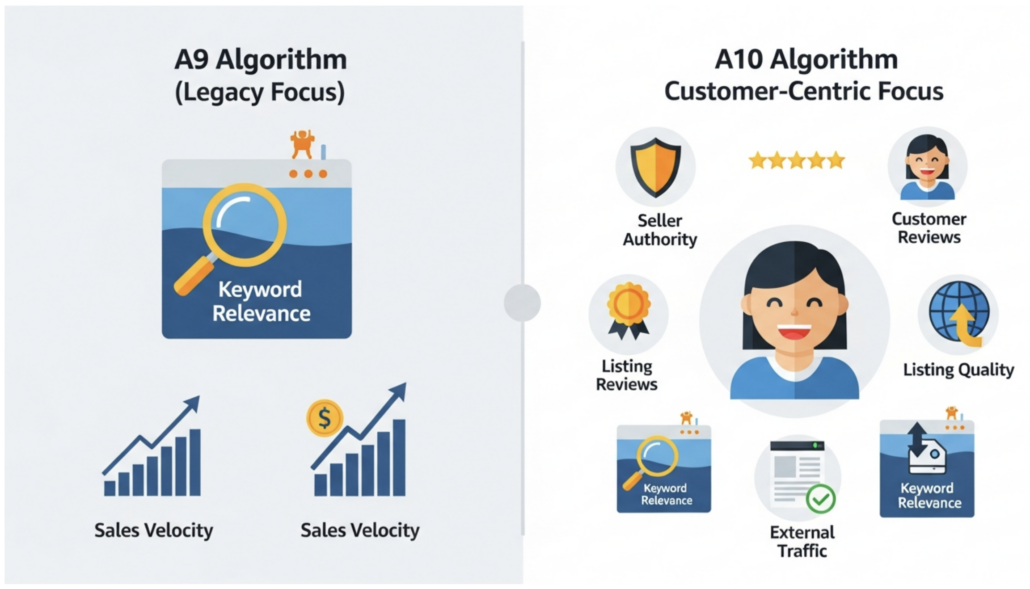
The A10 algorithm represents a shift from A9’s focus on sales and keywords to a broader, customer-centric model.
The Amazon A10 algorithm represents a significant evolution in how Amazon ranks products. Unlike its predecessor, A9, which leaned heavily on keyword relevance and sales volume, A10 places an even greater emphasis on the overall customer experience. It aims to deliver the most relevant, high-quality products to customers, fostering satisfaction and repeat business. This shift means that factors contributing to a positive customer journey are now critical components of your product’s ranking.
Why Mastering A10 is Essential for Your Amazon Success
In today’s competitive Amazon environment, simply listing a product is insufficient. Thousands of independent sellers achieve significant financial success, with over 55,000 generating more than $1 million in sales in 2024 alone. However, to reach these heights, sellers must adapt to A10’s customer-centric philosophy. Understanding and optimizing for A10 means increased organic visibility, better conversion rates, and sustained sales momentum, forming the bedrock of a thriving Amazon business.
What You’ll Learn: A Comprehensive Guide to A10 Optimization
This guide will provide a thorough breakdown of the Amazon A10 algorithm. You will learn about its core components, how it differs from previous iterations, and the critical factors that influence your product’s ranking. We will explore strategies for optimizing your product listings, driving customer engagement, building seller authority. And also, leveraging external traffic and advertising. By the end, you will have a clear, actionable framework to enhance your product ranking and overall performance on Amazon.
Deconstructing the Amazon A10 Algorithm: The Brain Behind the Buy Box
What is the Amazon A10 Algorithm?
The Amazon A10 algorithm is the complex, proprietary system Amazon uses to rank products in its search results and on product detail pages. It evaluates numerous data points related to a product, its listing, seller performance, and customer behavior to determine the most relevant and highest-converting items for any given search query or customer interest. The ultimate goal is to connect customers with the products they are most likely to buy and be satisfied with.
The Evolution from A9 to A10: A Paradigm Shift in Ranking Priorities
While A9 focused primarily on keyword matching and sales performance, A10 expands this by integrating a more holistic view of customer experience. This includes signals like customer reviews, return rates, and post-purchase satisfaction. The shift signifies Amazon’s increased commitment to ensuring customers receive not just the right product. But also a positive overall buying experience, which in turn drives loyalty to the Amazon platform.
How AI and Machine Learning Power A10’s Decisions
Artificial Intelligence (AI) and Machine Learning (ML) are the driving forces behind the A10 algorithm’s sophistication. These technologies enable Amazon to process vast amounts of data in real-time, identify complex patterns, and personalize search results for individual customers. AI allows A10 to understand nuanced search intent, predict customer behavior, and dynamically adjust rankings based on a multitude of ever-changing signals, ensuring a highly personalized and relevant shopping experience.
The Four Core Pillars of A10: Beyond Just Sales Velocity
A10’s ranking system can be broadly understood through four interconnected pillars: Relevancy and Listing Optimization, Organic Performance and Customer Engagement, Seller Authority and Trust Signals, and External Traffic and Advertising Synergy. Excelling in each of these areas is crucial for achieving and maintaining high product ranking.
Pillar 1: Relevancy and Listing Optimization for A10 Success
The Foundation: Strategic Keyword Research and Relevance
The cornerstone of any successful product listing is its relevance to customer search queries. Strategic keyword research, focusing on identifying terms customers actually use, is vital. This includes understanding buyer intent and incorporating those keywords naturally into your listing’s Titles, bullet points, descriptions, and backend search terms. High relevance ensures your product appears for the right searches, attracting qualified traffic.
Crafting High-Converting Product Listings
A well-optimized product listing goes beyond keywords. High-quality images that showcase your product from multiple angles are critical for attracting clicks and conversions. Compelling Titles and bullet points should highlight key features and benefits, while detailed descriptions provide further information. Engaging content, including A+ Content for registered brands, can significantly enhance customer experience and reduce bounce rates, signaling a high-potential product to A10.
Pillar 2: Driving Organic Performance & Customer Engagement
Sales Velocity and Sales History: The Engine of A10 Ranking
Sales velocity (the rate at which a product sells) and its overall sales history remain significant drivers of product ranking. Consistent sales indicate to Amazon that customers find your product valuable and are purchasing it. While A10 balances this with other factors, a strong sales track record is undeniable proof of a product’s market demand and desirability.
Conversion Rate Optimization (CRO) for A10 Success
A high conversion rate, meaning a large percentage of visitors to you
r product listing make a purchase, is a strong positive signal to A10. Optimizing your listing’s images, copy, pricing, and customer reviews directly impacts your conversion rate. Amazon wants to promote products that satisfy customers and generate sales, making CRO a critical component of your ranking strategy.
Customer Reviews: Quantity, Quality, and Sentiment Analysis
Customer reviews are a powerful indicator of product quality and customer satisfaction. A high volume of positive reviews, coupled with positive sentiment and minimal negative feedback, builds trust and signals to A10 that your product meets customer expectations. Actively encouraging reviews and addressing any negative feedback promptly can significantly boost your product’s perceived value.
Click-Through Rate (CTR) Optimization: Encouraging Discovery
The click-through rate (CTR) measures how often customers click on your product when it appears in search results or other placements. Compelling images and informative Titles are key to improving CTR. A higher CTR suggests that your product listing is attractive and relevant to potential buyers, which is a positive signal for the A10 algorithm.
Buy Box Winning Strategies: Fueling Sales Momentum
Winning the Buy Box is crucial for driving sales. This involves competitive pricing, fast shipping (ideally through Fulfillment by Amazon – FBA), and excellent seller performance. Consistently winning the Buy Box leads to increased sales velocity and a stronger sales history, directly impacting your product’s ranking positively within the A10 algorithm.
Pillar 3: Building Unshakeable Seller Authority and Trust Signals
What is Seller Authority in the Eyes of A10?
Seller authority refers to Amazon’s trust in your ability to consistently provide a positive customer experience. This is built through metrics such as your account health, order defect rate, on-time delivery, and customer service responsiveness. A seller with high authority is seen as reliable, reducing Amazon’s risk and making their products more likely to be promoted.
Prime Eligibility and Fulfillment by Amazon (FBA): A Core Trust Signal</h3>
Products eligible for Amazon Prime, often achieved through FBA, benefit from a significant trust signal. Prime offers c
ustomers fast, free shipping and easy returns, enhancing customer experience. This convenience leads to higher conversion rates and sales velocity, making FBA a strategic choice for boosting your product’s A10 ranking. Amazon Prime has approximately 250 million members globally [Backlinko, 2026], representing a massive customer base.
Brand Registry: Unlocking Advanced Tools and Protection
Enrolling in Amazon Brand Registry offers significant advantages. It provides enhanced brand protection against counterfeiters and unauthorized sellers. It also unlocks access to brand-specific advertising tools and A+ Content. Over 800,000 brands are now enrolled in Amazon Brand Registry worldwide [>Ecommerce Intelligence, 2025], underscoring its essential role for brand management and optimization.
Maintaining Stellar Account Health: A Direct Signal to A10
Your seller account health is a direct reflection of your performance. Metrics like order defect rate, cancellation rate, and late shipment rate are closely monitored by Amazon. Maintaining excellent account health is paramount, as it demonstrates reliability and a commitment to customer satisfaction, positively influencing your product ranking within the A10 algorithm.
Pillar 4: Leveraging External Traffic and Amazon Advertising Synergy
The Increasing Importance of External Traffic for A10
Driving external traffic where customers who come to your Amazon listing from outside the platform (e.g., social media, email marketing, influencers) is increasingly recognized by A10 as a powerful signal of product demand and desirability. This traffic often converts well and can indicate that your product has broad appeal beyond Amazon’s organic search.
Strategic Amazon Advertising (PPC) for A10 Synergy
Amazon Advertising (PPC) plays a crucial role in complementing organic efforts. Strategic campaigns can drive initial traffic and sales velocity, helping your product gain traction. Amazon’s advertising revenue reached $56.2 billion in 2024 [Amra & Elma, 2025], and its average conversion rate for sponsored product ads stands at 9.47% [VAPA, 2024], highlighting its effectiveness. Amazon Ads generated over $40 billion in revenue in 2024 [Amify, 2025], demonstrating its market significance.
Balancing Organic Growth with Paid Campaigns
The key is to create synergy between organic ranking efforts and paid advertising. Use PPC to kickstart sales, gather data, and improve your organic ranking factors. As your organic visibility improves, you can potentially reduce reliance on paid ads. This balanced approach ensures sustainable growth and maximizes your return on investment.
Advanced Strategies & Future-Proofing Your A10 Approach
Continuously monitor your product performance using Seller Central analytics. Pay attention to keyword ranking reports, conversion rates, and customer feedback. The A10 algorithm is dynamic; staying informed about Amazon’s policy changes and emerging trends is crucial. Avoid common pitfalls like keyword stuffing, which can harm your listing and lead to penalties. Future-proofing your approach means building a strong brand, prioritizing customer experience, and adapting proactively to algorithmic updates.
Conclusion
The Amazon A10 algorithm represents a sophisticated evolution in online retail, prioritizing customer satisfaction and a holistic buying experience. For sellers, this means moving beyond simple keyword optimization. It means embracing a comprehensive strategy that encompasses relevancy, listing quality, organic performance, seller authority, and the strategic integration of external traffic and advertising.
But by understanding and aligning with the four core pillars of A10 (Relevancy, Organic Performance, Seller Authority, and External Traffic Synergy) you can significantly improve your product ranking, drive more sales, and build a sustainable and thriving business on Amazon. Furthermore, continuously adapt, prioritize your customer, and leverage data and you will navigate the ever-evolving landscape and achieve lasting success.
<br />