

The Ultimate Guide to Auditing & Fixing Underperforming Amazon Listings
Amazon is massive, and the opportunity is real.
But the size of the marketplace also means competition is tight, and small mistakes can quietly hold a product back.
For many sellers, the frustration of seeing high impressions without corresponding sales, or campaigns bleeding ad spend with little return, is a common challenge.
In 2023, Amazon’s advertising revenue grew 24% compared to the previous year, demonstrating the channel’s growing importance for sellers Amazon’s advertising revenue grew 24% compared to the previous year.
This surge underscores the necessity of mastering listing optimization to capture this advertising potential.
This guide will equip you with a comprehensive audit framework and actionable strategies to transform your underperforming Amazon listings into robust sales drivers.
Decoding Underperformance; When & Why Your Listings Fail
Recognizing the signs of a struggling product listing is the critical first step toward revitalization. Underperformance isn’t always obvious; it often lurks beneath surface-level metrics, indicating deeper issues that are costing you valuable sales and potential.
Identifying the Red Flags: Performance Metrics that Matter
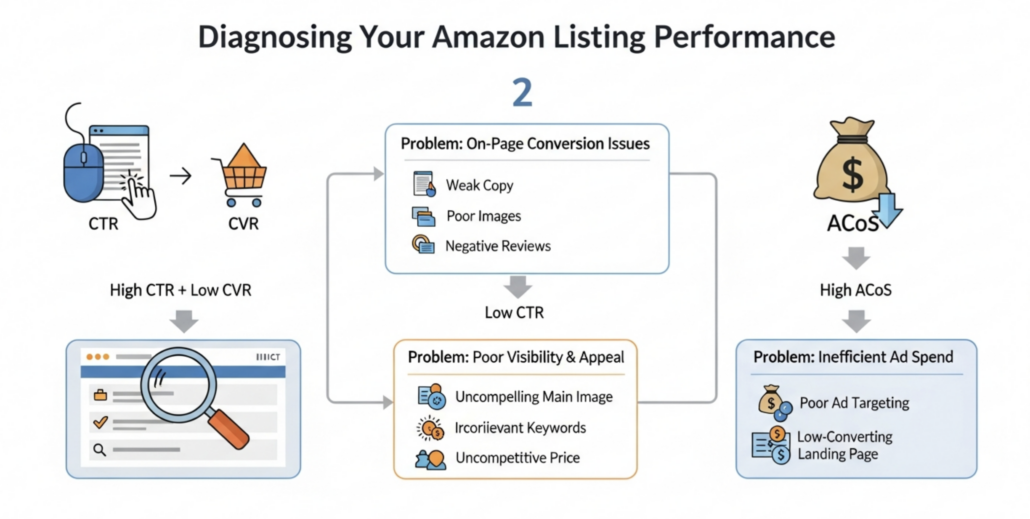
Use this diagnostic chart to interpret your key metrics and quickly identify the root cause of underperformance.
A close examination of key performance indicators (KPIs) will illuminate whether your listing is meeting its potential. Low sales velocity is the most apparent symptom, but the diagnostic work must go deeper.
Pay close attention to your Click-Through Rate (CTR) and Conversion Rate (CVR). A high CTR with a low CVR suggests that while your listing is attracting attention, the page content isn’t convincing shoppers to buy.
Conversely, a low CTR indicates your listing isn’t appearing in relevant searches or isn’t compelling enough to click on.
Monitoring your ACoS (Advertising Cost of Sale) is also crucial; a high ACoS often points to inefficient ad spend driven by a poor-performing listing. Furthermore, consider your Buy Box percentage, organic keyword rankings, and customer feedback.
A consistently low Buy Box win rate or a decline in keyword positions signals trouble. In 2025, the average conversion rate for Amazon advertising campaigns typically ranges from 9.5% to 10%, significantly outperforming the average eCommerce conversion rate of around 1.33% on non-Amazon platforms average conversion rate for Amazon advertising campaigns typically ranges from 9.5% to 10%. This benchmark highlights the significant opportunity for improvement.
Common Root Causes of Underperformance
Several factors commonly contribute to a listing’s failure to convert. A primary culprit is often poor keyword research and targeting, meaning your product isn’t being found by the right audience. This ties directly into the effectiveness of your title and bullet points, which must be keyword-rich, benefit-driven, and clear. Inadequate or unoptimized images are another significant deterrent; if shoppers can’t visualize the product clearly or understand its features, they won’t buy.
A lack of compelling A+ Content for brands can also result in missed opportunities to build trust and showcase the product’s value. Uncompetitive pricing, while seemingly straightforward, can dramatically impact sales. Negative reviews and feedback are toxic to a listing’s reputation, deterring potential buyers and signaling quality or service issues to Amazon’s algorithm. Technical issues, such as incorrect indexing or suppressed ASINs, can render a listing invisible.
The Comprehensive Amazon Listing Audit Framework
A systematic audit is essential for diagnosing and rectifying issues within your product listings. This framework breaks down the process into actionable steps, ensuring no critical element is overlooked.
Step 1: Core Content Audit
This foundational audit focuses on the customer-facing elements of your listing and how they communicate with Amazon’s search algorithm. Start with your product title. Is it clear, concise, and keyword-rich? Does it accurately reflect the product and entice clicks? Next, scrutinize your bullet points.
These should highlight your product’s key benefits and features, answering potential customer questions proactively. Ensure they are easy to read, especially on mobile devices. Images are paramount; Amazon’s marketplace data indicates that using high-resolution images (capable of zoom) can increase sales by up to 10% using high-resolution images (capable of zoom) can increase sales by up to 10%.
Verify that your images are high-quality, showcase the product from multiple angles, include lifestyle shots, and clearly convey key selling points. For registered brands, A+ Content is non-negotiable. This is your opportunity for rich storytelling, detailed product comparisons, and enhanced brand visuals.
Step 2: Technical & Indexing Audit
Visibility on Amazon hinges on technical accuracy and proper indexing. A critical part of this audit is verifying that your product is indexed for all relevant keywords. Use tools to check if your listing appears in search results for the terms you’re targeting. Examine your backend search terms and ensure they are utilized effectively without stuffing.
Identify any suppressed or inactive listings (ASINs) and determine the cause, whether it’s a policy violation or missing mandatory information. Incorrect category classification can also hinder discoverability. Furthermore, review your parent-child product variation relationships to ensure they are set up correctly, preventing confusion for customers and problems with inventory allocation.
Step 3: Competitive & Pricing Audit
Understanding your competitive landscape is vital. Audit your pricing strategy regularly. Is your product priced competitively against similar offerings? Are you perceived as offering good value? Analyze top-performing competitor listings in your niche. What are they doing well in terms of their titles, images, bullet points, and pricing? Pay close attention to their customer reviews. Identify common themes in both positive and negative feedback to understand what resonates with customers and where competitors might be falling short. This competitive intelligence can inform your own listing optimization efforts and pricing adjustments.
Section 3: The Synergy Audit; Connecting Listings to Broader Amazon Success
An effective listing doesn’t operate in a vacuum. Its performance is intrinsically linked to other crucial aspects of your Amazon business.
Listing Quality & Amazon PPC Performance: The Ultimate Partnership
Your listing’s quality directly impacts the efficiency of your Amazon PPC campaigns. A product listing with a low Conversion Rate will cause your ad spend to be wasted, as clicks don’t translate into sales. This results in a higher ACoS. Conversely, an optimized listing with compelling content and high-quality images can significantly improve your CTR and CVR, leading to better campaign performance, lower ad spend, and a more favorable ACoS.
Sponsored Brands campaigns using AI-generated lifestyle images delivered a 10.3 percent higher ROAS compared to campaigns without AI images, according to Amazon Ads data Sponsored Brands campaigns using AI-generated lifestyle images delivered a 10.3 percent higher ROAS. Aligning your PPC keywords with the terms naturally integrated into your listing is also paramount for campaign success.
Listing Health & Overall Account Health: A Critical Link
Poor listing health can have serious repercussions for your entire Amazon account. Policy violations stemming from non-compliant listing content, such as prohibited claims or intellectual property issues, can lead to listing suppression, warnings, or even account suspension. Maintaining high listing quality contributes to a positive customer experience, which in turn bolsters your seller metrics and overall account health. A healthy account is more likely to be favored by Amazon’s algorithm, leading to better visibility and more opportunities.
The Strategic Role of Inventory: Ensuring Continuity
Inventory management is a silent but powerful driver of listing success. Frequent stockouts can decimate your listing’s momentum. When a product is out of stock, it loses its Buy Box eligibility, its sales rank plummets, and it can be de-indexed for certain keywords. This forces you to rebuild your listing’s authority from scratch once re-stocked.
Conversely, overstocking can lead to excessive storage fees and tie up capital. Maintaining optimal inventory levels ensures that your optimized listing is always available to convert shoppers, maximizing your return on ad spend and overall sales potential. In 2024, independent sellers in the US averaged more than $290,000 in annual sales in the Amazon store independent sellers in the US averaged more than $290,000 in annual sales. Effective inventory management is key to achieving this level of success.
Section 4: Advanced Fixing Strategies & Ongoing Optimization
Once your audit is complete and issues are identified, it’s time to implement targeted fixes and establish a process for continuous improvement.
Prioritizing Fixes for Maximum ROI
Not all listing improvements yield the same results. Prioritize your fixes based on their potential impact and ease of implementation. Start with high-impact, low-effort changes. Optimizing your product title and primary images often provides a significant boost in CTR and initial conversion. Addressing critical negative feedback or fixing indexing issues should also be high on the list. Consider the cost and time involved for each fix.
A framework that weighs the potential lift in conversion rate or CTR against the resources required will help you focus your efforts for maximum ROI. More than 60% of sales in the Amazon store are from independent sellers more than 60% of sales in the Amazon store are from independent sellers, underscoring the need for effective optimization strategies.
Implementing Listing Improvements & Iterative Testing
Make your prioritized changes to the listing. This could involve rewriting your title, updating images, refining bullet points, adding or improving A+ Content, or adjusting pricing. Crucially, monitor the impact of these changes closely. Amazon’s marketplace data indicates that using high-resolution images (capable of zoom) can increase sales by up to 10% using high-resolution images (capable of zoom) can increase sales by up to 10%. Implement A/B testing where possible, experimenting with different titles or images to see what performs best.
Leveraging Advanced Tools & Services
While manual audits are valuable, advanced tools can streamline the process. Software like Helium 10, Jungle Scout, or Sellics can provide in-depth keyword analysis, competitor tracking, listing health scores, and indexing reports. These tools can identify issues you might miss and offer data-driven recommendations. For complex issues or if you lack the time or expertise, consider engaging with experienced listing optimization specialists or Amazon PPC agencies. They can offer tailored strategies and execution.
Addressing Policy Violations & Suppressed Listings
Policy violations are a serious threat to your Amazon business. If your listing has been suppressed or flagged, act swiftly. Carefully review Amazon’s communication to understand the specific violation.
This might involve removing unapproved claims, updating product information, or ensuring compliance with restricted product policies. Providing accurate and compelling documentation to Amazon support is often necessary for reinstatement. Proactive auditing that adheres to Amazon’s guidelines can prevent these issues from arising in the first place.
Conclusion: Your Blueprint for Sustained Amazon Success
Transforming underperforming Amazon listings from liabilities into revenue generators is an achievable goal. It requires a commitment to diligent auditing, strategic listing optimization, and a holistic understanding of how your product listings integrate with your broader Amazon strategy.
By systematically decoding underperformance, conducting thorough content, technical, and competitive audits, and recognizing the synergistic relationship between listing health, PPC campaigns, account health, and inventory, you establish a robust foundation for growth. Prioritize your fixes for maximum ROI, embrace iterative testing, and leverage the right tools to refine your approach.
Remember that Amazon is a constantly evolving marketplace; continuous monitoring and proactive optimization are not optional, but essential for sustained success and capturing the full potential of selling on the platform. This blueprint empowers you to move beyond guesswork and implement a data-driven strategy for lasting results.